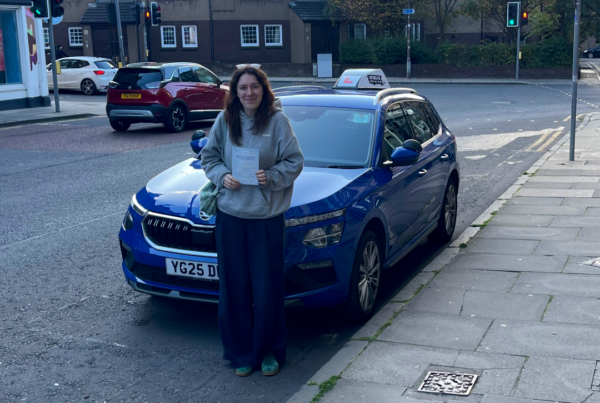
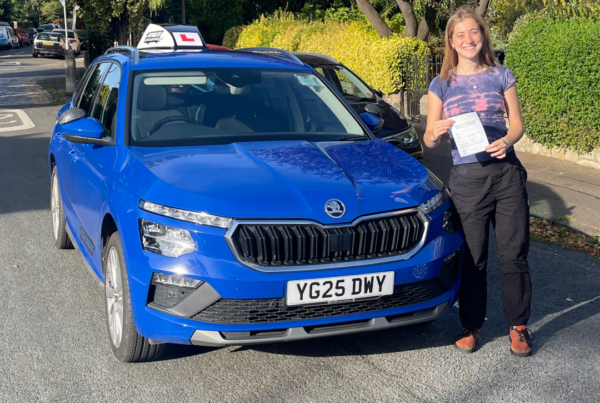
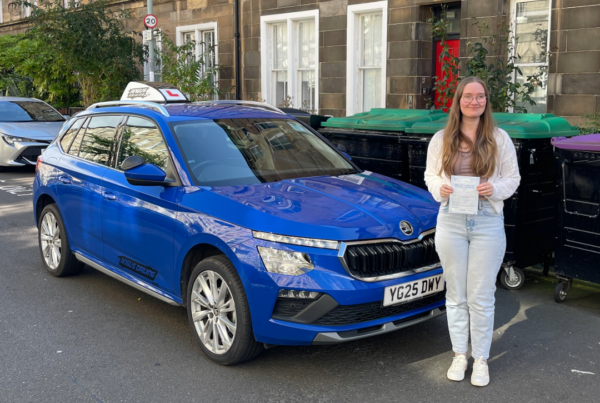
Alice was progressing faster than expected, so when the chance came to bring her driving test forward by two months, we took it.
Alice lives centrally in Edinburgh, close to the Meadows and Summerhall, and got in touch after being recommended by one of her friends. She had already completed some driving lessons with another instructor, so when we started going out together at the beginning of summer 2026, the first job was to work out exactly where she was with her driving.
Whenever someone comes to me with previous experience, I like to spend the first lesson finding out which skills are already in place and whether there are any gaps that we need to fill.
For Alice, we headed to the Grange.
It’s an area I really like for this because the grid of residential streets gives us plenty of junctions, with parked cars, walls and hedges making visibility challenging in places. There is also a mixture of gradients, giving us uphill, downhill and level junctions to work with.
One of the first things we concentrated on was Alice’s control of the pedals. With three pedals and only two feet, I always want to make sure that one foot isn’t effectively telling the car to go while the other is telling it to stop.
At uphill junctions, we worked on getting the car settled and finding the biting point when required. Downhill, we could use gravity to our advantage, controlling the car gently with the brake and bringing the clutch down when needed.
Alice picked this up very quickly.
By the end of that first lesson, we were already doing laps around Morningside and it was obvious that we had a really good foundation to build on.
From there, we went out weekly and gradually worked through everything we needed to cover.
Living centrally meant Alice got plenty of experience with Edinburgh’s busy urban roads. Pedestrian crossings, buses, cyclists, yellow box junctions, bin lorries and all the other things Edinburgh can throw at you became part of everyday driving.
We then started concentrating on roundabouts, using a loop around Colinton Mains, Dreghorn and Redford Barracks. It gave us a great selection of left turns, right turns and straight-ahead routes, allowing Alice to repeat the process until everything became much more natural.
As with anyone learning to drive, there were mistakes along the way. What impressed me was how quickly Alice understood them, learned from them and moved on.
Next came the manoeuvres. We covered two during one lesson and the other two the following week, along with driving on the bypass.
Before we knew it, we’d covered the full syllabus.
The next stage was a mock driving test.
A mock is really useful because it changes the dynamic of the lesson. Rather than me helping as we go, Alice had to make her own decisions. If something didn’t go quite to plan, the important question became: could she recognise it, recover and continue driving safely?
Our first mock gave us exactly what we needed — a clear list of things to improve.
Most importantly, Alice understood the points we discussed afterwards. We could turn those into a plan, practise them and then try another mock a few weeks later.
By August, that second mock showed a noticeable improvement. There were still details to work on, but everything was heading in the right direction.
Alice already had a driving test booked for December. We could have kept that date and started spacing the lessons out, but it increasingly felt unnecessary. She was progressing quickly and I was confident we’d have her ready much sooner.
Luckily, through one of the Edinburgh driving instructor groups I’m part of, I found another instructor whose pupil had an October test but needed more time.
Their October date and Alice’s December date suited each other perfectly.
We arranged the swap.
Suddenly, instead of having months to wait, Alice had just over a month until her driving test.
That gave our remaining lessons a very clear purpose. Each time we went out, we’d make a plan based on what Alice felt needed attention and work through it together.
One area Alice wanted more confidence with was reversing into a bay, so we simply did more of it. The aim wasn’t for her to be able to do it correctly once — we wanted it to become consistently good, while also making sure she knew how to correct it if something didn’t go perfectly.
That’s particularly important before a driving test. Nerves can easily knock someone’s normal standard down slightly, so I want pupils arriving at the test centre with some margin for that. Rather than being just good enough beforehand, I want the driving to be consistently above the level required.
By test week, that’s exactly where Alice was.
Her test was at 1:25pm at the Currie Test Centre. I collected her at lunchtime and we had around an hour and a half for one final warm-up.
We covered each manoeuvre, completed an emergency stop and went through a good mixture of driving before arriving at the test centre.
Alice had driven really well. I was extremely confident that if she simply repeated what she’d been doing with me, everything would be fine.
We parked up, headed inside and Alice met her examiner.
Then it was my turn to wait.
When they returned, Alice had done even better than I could have hoped.
She had passed her driving test on her first attempt with just one driver fault.
The examiner described the drive as very good and consistent, with very little that needed discussing afterwards.
Brilliant.
Instead of waiting until December, Alice is now on the road two months earlier than originally planned. Hopefully the next step will be getting insured on her boyfriend’s car and continuing to build on everything she’s learned.
Alice was always enthusiastic, asked questions whenever she was unsure and was very good at telling me which areas she wanted more confidence with. That made it easy for us to tailor the lessons around exactly what she needed.
Well done, Alice. One driver fault and a first-time pass — a fantastic drive and thoroughly deserved.